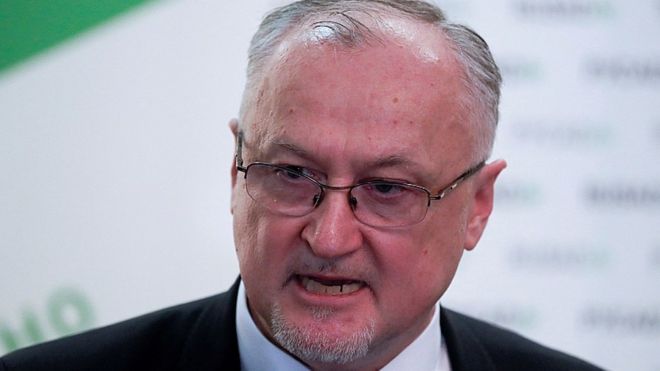
Yuri Ganus: Russia sacks head of sports anti-doping agency


Yuri Ganus in 2019Image copyrightREUTERS
Image captionYuri Ganus was appointed three years ago after a series of Russian doping scandals

Russia has dismissed the outspoken head of its national anti-doping agency, Rusada, after the country's Olympic committee accused him of presiding over serious financial violations.

Yuri Ganus, who denied the allegations, said he was being removed because of his zero-tolerance approach to doping.

The World Anti-Doping Agency (Wada) has voiced concern at his dismissal.

Mr Ganus was appointed three years ago on a mission to clean up Russian sport after multiple doping scandals.

He took a tough approach, increasing spot checks on athletes and refusing a request for a five-minute warning when inspectors were on their way.

Last December, Wada banned Russia from big global sporting events for four years, including the Tokyo Olympics and the 2022 World Cup in Qatar.

Mr Gunus's sacking comes as Rusada is awaiting the result of its appeal against the ban. BBC Moscow correspondent Sarah Rainsford says that proving Russia's anti-doping agency is fully independent would be a key condition for overturning it.

The appeal will be heard by the Court of Arbitration for Sport, based Lausanne, Switzerland, in November.

Yuliya Stepanova talks to the BBC for the 100 Women season about the cheating, cover-ups and life on the run.

Stanislav Pozdnyakov, president of the Russian Olympic Committee, told reporters the decision to dismiss Mr Ganus had been unanimous.

"We are certain that Rusada's operations will remain independent," he said.

Mikhail Bukhanov, a lawyer at Rusada, will serve as acting head until a new director is appointed, Mr Pozdnyakov added.


2px presentational grey line
Analysis box by Sarah Rainsford, Moscow correspondent

The appointment of Yuri Ganus was seen as a fresh start: a sign to the rest of the world that Russia was cleaning up its act in sport after multiple scandals over doping.

His reforms and principles angered some here, and last December he told the BBC he had had death threats. Then this year an audit uncovered apparent "irregularities" in Rusada's finances. Now the DG has been removed following a unanimous vote.

Mr Ganus has called the report "deliberately fabricated" and believes he's being targeted for being so outspoken about the persistent problems with cheating in Russian sport. In a chilling recent tweet, Mr Ganus wrote that he loved life and was in no way suicidal: he explained that was because in 2016, his two predecessors died in swift succession.

2px presentational grey line

Wada said it had contacted Russian authorities to seek clarification about Mr Ganus's departure.

"It is a critical element of the World Anti-Doping Code that national anti-doping organisations, such as Rusada, remain safe from interference in their operational decisions and activities in order to conduct their work independently and effectively," the agency said in a statement.

Last year, Wada's Compliance Review Committee declared Rusada non-compliant over inconsistencies in a key database of athletes' test results.

Mr Ganus later confirmed that someone had altered or deleted "thousands" of entries.
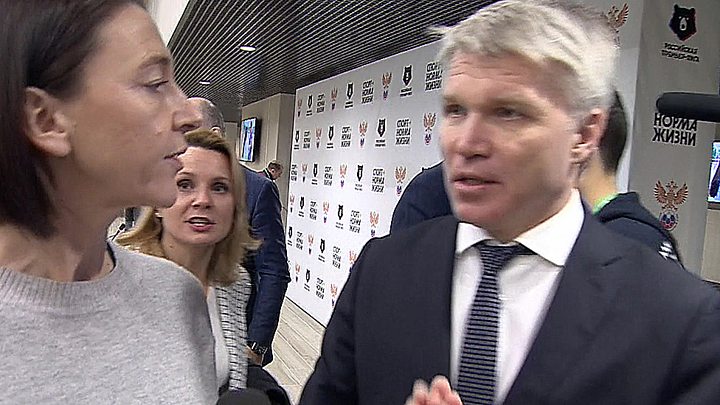
Media captionRussian Sports Minister Pavel Kolobkov avoids questions from the BBC's Sarah Rainsford

Comments

Popular posts from this blog

Coronavirus: Can California's economy survive the latest surge?

  Image copyright EPA Image caption California's coronavirus outbreak is hurting the tourism industry Earlier this year, California was praised for an early lockdown, which helped stem the pandemic in the US state. But cases have since surged. What's next for the Golden State, known for Hollywood, sunshine and celebrity? Scott DeAngelis spent a decade building up a lucrative tour guide operation on Hollywood Boulevard. For years tourists flocked to the Hollywood Walk of Fame and there was always enough work to go around. But now there are more palm trees than people and the stars once hard to find under the feet of potential customers, now bake, exposed to the midday sun. Hope was briefly on the horizon when California Governor Gavin Newsom announced a phased reopening plan. He said it would be a dimmer switch, gradually shining a brighter light at the end of this dark tunnel. But cases began to rise again after the Memorial Day weekend in late May - and the dimmer switch has n...

Coronavirus: Are women and children less affected?

  Image copyright SCIENCE PHOTO LIBRARY Women seem to be less likely to die from coronavirus than men, and children appear to be less likely to die than other age groups. Most people will get a mild infection, but the pattern is clear in the most severe cases. So what is going on? All the information we have is coming from a massive study by the Chinese Centres of Disease Control. It looked at 44,000 people and showed 2.8% of infected men died, compared with 1.7% of women. And 0.2% of children and teenagers died compared with nearly 15% of people over the age of 80. Are women and children less likely to catch coronavirus? There are two ways of explaining the findings. Either these groups are less likely to be infected in the first place, or their bodies are more able to cope with the virus. "Normally with new viruses circulating, everybody gets infected: that's the important point," says Dr Bharat Pankhania, from the University of Exeter. This is because there is no imm...

Coronavirus: How will deaf schoolchildren cope with face coverings? And other questions

  Children are returning to school throughout the UK, many of them for the first time since lockdown in March. Here are some of your questions about the challenges ahead. Questions and answers Back to school Your questions Skip Back to school Is it a good idea to send kids back to school if they have a heart problem? from Zoe Corran in Bangor BBC News People who have a serious heart condition are more vulnerable to coronavirus. Many children with heart conditions will, until recently, have been shielding to protect themselves. Experts are now looking into whether as many children will need to shield in the future,  given the reduced level of risk posed to children. Across the UK, children who have been shielding are expected to return to school. However, if a child has an extremely serious condition, your doctor can advice otherwise and parents should engage with the child’s school about the best way to continue their studies. If there is an increase in cases in an area and ...