Kim Jong-un warns over North Korea typhoon and coronavirus


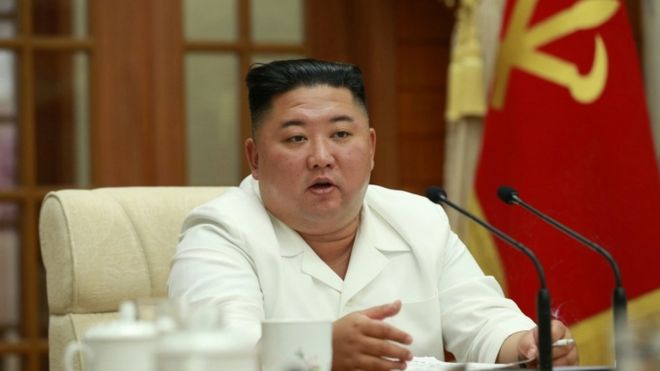
Kim Jong-un chairs a meeting on 25 AugImage copyrightREUTERS
Image captionKim's appearance contradicts recent rumours that he was gravely ill

Kim Jong-un has warned North Korean authorities to prepare for the dangers posed to the country by the coronavirus pandemic and a looming typhoon.

Mr Kim's appearance at a party meeting comes after widespread speculation over his health.

North Korea has not confirmed any Covid-19 cases and it is thought that a large outbreak would have a devastating effect on the impoverished nation.

Meanwhile Typhoon Bavi is expected to hit North Korea later this week.

Speaking at a meeting of the politburo on Tuesday, Mr Kim, who was smoking a cigarette, said there were "some shortcomings" in the state's efforts to keep out the "malignant virus", state media reported, without giving details.
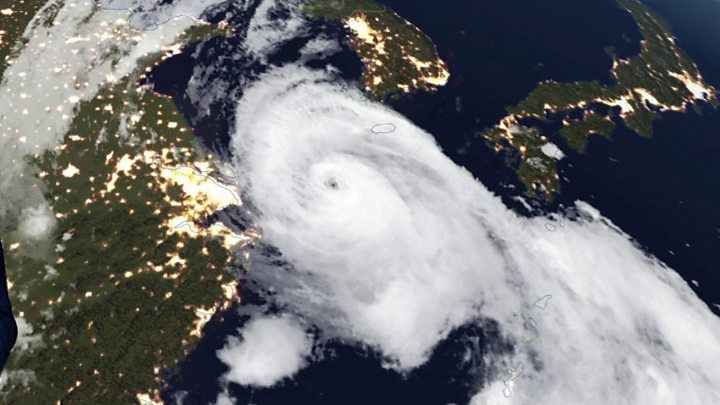
Media captionStrong winds, heavy rain and rough seas expected from Typhoon Bavi

Pyongyang for a long time insisted there were no infections in the country, though this was doubted by observers. No cases have been declared, but its media have not repeated the claim for several weeks now.

After a suspected case, there had been a lockdown in one border city near South Korea but the infection was never officially confirmed.

Kim Jong-un's appearance came amid rumours about his health and that he had delegated some of his authority to his sister Kim Yo-jong.

Speculation about the health of the North Korean leader is not unusual but has so far always turned out to be false.

Analysis box by Laura Bicker, Seoul correspondent

While the world's tabloids obsess over Kim Jong-un - who is clearly fine - there are bigger concerns. The state and its 25 million people are clearly not fine.

Typhoon Bavi could cause damage in a country already reeling from one of the longest monsoon seasons on record. Torrential rain in August brought widespread flooding.

And now the BBC's weather centre is predicting storm surges of between 200-300mm of rain just weeks before the autumn rice harvest.

Ten million people are said to suffer from food insecurity in North Korea, according the UN. That means they live from harvest to harvest. They cannot afford more crops to be damaged.

North Korea has also gone from insisting it had zero cases of Covid-19 to holding yet another high level meeting to discuss ways to mitigate the effects of the virus.

We still don't know if outbreaks are under control in the secretive state, which closed its borders to the world in January.

Just last week, Mr Kim admitted that his big economic plan, which was due to come to fruition in 2020, had failed and he was having to come up with a new one. A rare admission from a North Korean leader that he has come up short.

Trade with China, the nation's biggest benefactor and ally, was down over 20% in July, according to Chinese customs data. Border closures to prevent coronavirus entering the country have had an impact on the vital supply chain.

NK News has also reported that foreign embassy staff and the majority of NGO's in the country have left due to the severe virus restrictions.

2020 has been a bad year for most of the world. But for North Korea it has the potential to be devastating and there are very few organisations available in the country to notice and help.

Comments

Popular posts from this blog

Coronavirus: Can California's economy survive the latest surge?

  Image copyright EPA Image caption California's coronavirus outbreak is hurting the tourism industry Earlier this year, California was praised for an early lockdown, which helped stem the pandemic in the US state. But cases have since surged. What's next for the Golden State, known for Hollywood, sunshine and celebrity? Scott DeAngelis spent a decade building up a lucrative tour guide operation on Hollywood Boulevard. For years tourists flocked to the Hollywood Walk of Fame and there was always enough work to go around. But now there are more palm trees than people and the stars once hard to find under the feet of potential customers, now bake, exposed to the midday sun. Hope was briefly on the horizon when California Governor Gavin Newsom announced a phased reopening plan. He said it would be a dimmer switch, gradually shining a brighter light at the end of this dark tunnel. But cases began to rise again after the Memorial Day weekend in late May - and the dimmer switch has n...

Coronavirus: Are women and children less affected?

  Image copyright SCIENCE PHOTO LIBRARY Women seem to be less likely to die from coronavirus than men, and children appear to be less likely to die than other age groups. Most people will get a mild infection, but the pattern is clear in the most severe cases. So what is going on? All the information we have is coming from a massive study by the Chinese Centres of Disease Control. It looked at 44,000 people and showed 2.8% of infected men died, compared with 1.7% of women. And 0.2% of children and teenagers died compared with nearly 15% of people over the age of 80. Are women and children less likely to catch coronavirus? There are two ways of explaining the findings. Either these groups are less likely to be infected in the first place, or their bodies are more able to cope with the virus. "Normally with new viruses circulating, everybody gets infected: that's the important point," says Dr Bharat Pankhania, from the University of Exeter. This is because there is no imm...

Coronavirus: How will deaf schoolchildren cope with face coverings? And other questions

  Children are returning to school throughout the UK, many of them for the first time since lockdown in March. Here are some of your questions about the challenges ahead. Questions and answers Back to school Your questions Skip Back to school Is it a good idea to send kids back to school if they have a heart problem? from Zoe Corran in Bangor BBC News People who have a serious heart condition are more vulnerable to coronavirus. Many children with heart conditions will, until recently, have been shielding to protect themselves. Experts are now looking into whether as many children will need to shield in the future,  given the reduced level of risk posed to children. Across the UK, children who have been shielding are expected to return to school. However, if a child has an extremely serious condition, your doctor can advice otherwise and parents should engage with the child’s school about the best way to continue their studies. If there is an increase in cases in an area and ...