France Covid-19: Paris compulsory face-mask rule comes into force


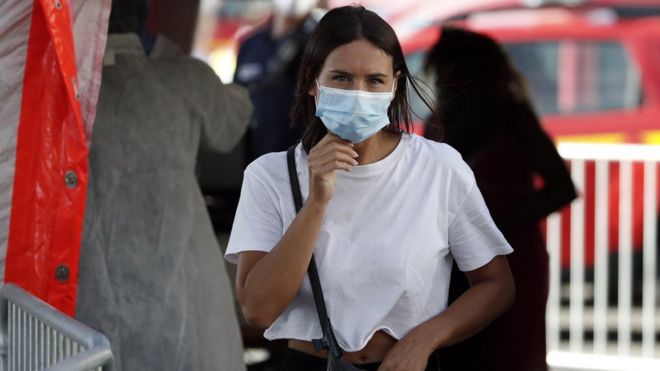
A woman wearing a protective face mask leaves after her swab samples are taken by volunteering firefighters at a test station for Covid-19 coronavirus in Marseille, France,Image copyrightEPA
Image captionMasks were made compulsory in Marseille and Paris is now likely to have the same rule

Wearing a face-mask in public has become mandatory across Paris and several surrounding areas, amid a surge in Covid-19 cases in France.

The move comes a day after the country recorded 6,111 new infections - its highest number since early May.

The number of "red zones" where the virus is in active circulation has risen from two to 21.

Announcing new local curbs on Thursday, PM Jean Castex said he wanted to avoid another general lockdown.

He said the coronavirus was "gaining ground" across France, and that if the government did not act fast infection growth could become "exponential".

Despite a sharp rise in cases in recent weeks, daily death tolls have remained low. Overall, more than 30,500 people have died and almost 300,000 have been infected in France.

A number of European countries are seeing a surge in new cases, and Germany is also planning tighter rules.

Chancellor Angela Merkel warned on Friday that in the coming months things would become "even more difficult than now", as people have been able to enjoy life outdoors over the summer.

Masks for Paris

The French prime minister said all pedestrians would have to wear face masks in public areas in the capital from 08:00 on Friday (06:00 GMT).

While individual streets and areas of the capital already have rules on wearing face-coverings, this new rule will be far more extensive, covering not only Paris but its inner ring of Seine-Saint-Denis, Hauts-de-Seine and Val-de-Marne.

line

Last-minute reprieve for cyclists and joggers

Analysis box by Lucy Williamson, Paris correspondent

Mask-wearing has taken over the streets of Paris by stealth over the past few months, and the blanket enforcement of face-masks in and around the capital from 08:00 triggered little real outcry, except for one thing: the new rules were originally designed to apply to cyclists and runners, along with pedestrians.

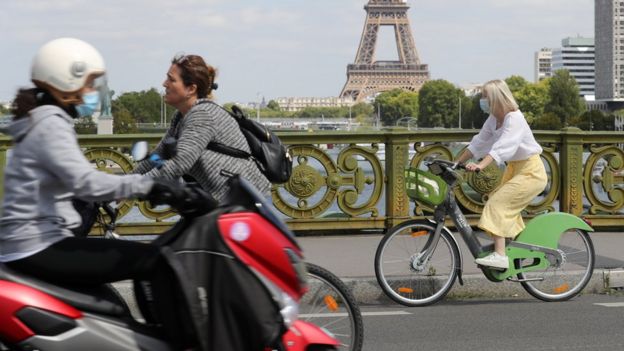
By the time the regulation came into force this morning, Paris city hall had intervened, and won a reprieve, saying it was "dangerous" and "counterproductive" to force these two groups to wear masks, especially when the mayor has been encouraging people to cycle to work to relieve pressure on public transport.
Cyclists in front of the Eiffel TowerImage copyrightGETTY IMAGES
Image captionWhile cyclists have been given a reprieve, the rules still stand for motorcyclists and people on scooters

Runners and cyclists aside, only a handful of people were still out without a mask in my neighbourhood this morning, and there seems to be a lot of support for the measure around the capital.

"It's better than being locked down," one woman said. Another resident said the government should have brought it in earlier, so that "the situation wouldn't have got as bad as it is now".

line

Paris is already a red zone, along with the southern area of Bouches-du-Rhône, where France's second-largest city Marseille made masks compulsory from Wednesday evening.

A broad expanse of the Mediterranean coast and the Gironde area around Bordeaux are also red zones.

Comments

Popular posts from this blog

Coronavirus: Can California's economy survive the latest surge?

  Image copyright EPA Image caption California's coronavirus outbreak is hurting the tourism industry Earlier this year, California was praised for an early lockdown, which helped stem the pandemic in the US state. But cases have since surged. What's next for the Golden State, known for Hollywood, sunshine and celebrity? Scott DeAngelis spent a decade building up a lucrative tour guide operation on Hollywood Boulevard. For years tourists flocked to the Hollywood Walk of Fame and there was always enough work to go around. But now there are more palm trees than people and the stars once hard to find under the feet of potential customers, now bake, exposed to the midday sun. Hope was briefly on the horizon when California Governor Gavin Newsom announced a phased reopening plan. He said it would be a dimmer switch, gradually shining a brighter light at the end of this dark tunnel. But cases began to rise again after the Memorial Day weekend in late May - and the dimmer switch has n...

Coronavirus: Are women and children less affected?

  Image copyright SCIENCE PHOTO LIBRARY Women seem to be less likely to die from coronavirus than men, and children appear to be less likely to die than other age groups. Most people will get a mild infection, but the pattern is clear in the most severe cases. So what is going on? All the information we have is coming from a massive study by the Chinese Centres of Disease Control. It looked at 44,000 people and showed 2.8% of infected men died, compared with 1.7% of women. And 0.2% of children and teenagers died compared with nearly 15% of people over the age of 80. Are women and children less likely to catch coronavirus? There are two ways of explaining the findings. Either these groups are less likely to be infected in the first place, or their bodies are more able to cope with the virus. "Normally with new viruses circulating, everybody gets infected: that's the important point," says Dr Bharat Pankhania, from the University of Exeter. This is because there is no imm...

Coronavirus: How will deaf schoolchildren cope with face coverings? And other questions

  Children are returning to school throughout the UK, many of them for the first time since lockdown in March. Here are some of your questions about the challenges ahead. Questions and answers Back to school Your questions Skip Back to school Is it a good idea to send kids back to school if they have a heart problem? from Zoe Corran in Bangor BBC News People who have a serious heart condition are more vulnerable to coronavirus. Many children with heart conditions will, until recently, have been shielding to protect themselves. Experts are now looking into whether as many children will need to shield in the future,  given the reduced level of risk posed to children. Across the UK, children who have been shielding are expected to return to school. However, if a child has an extremely serious condition, your doctor can advice otherwise and parents should engage with the child’s school about the best way to continue their studies. If there is an increase in cases in an area and ...