GETTY IMAGES
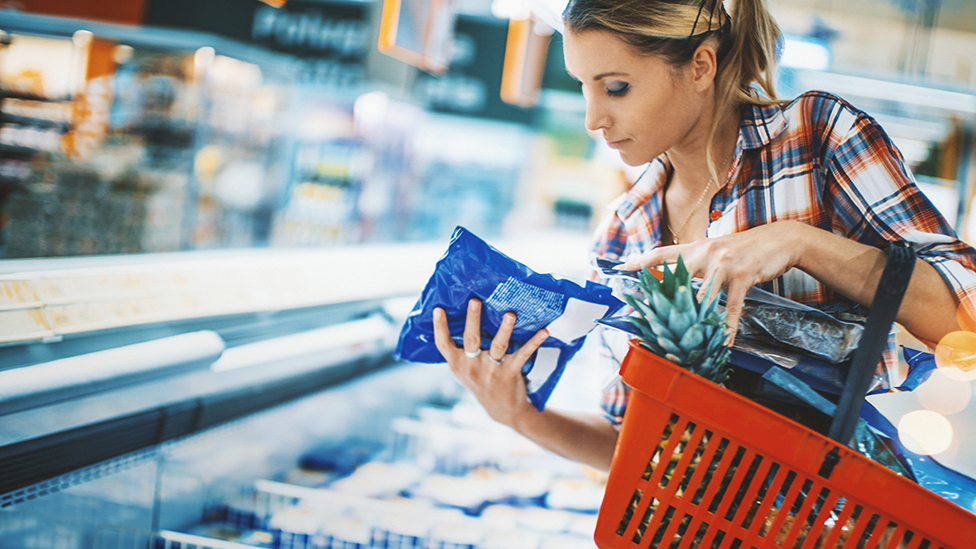
Traces of the coronavirus were reportedly found on packaging in China recently, on consignments of frozen shrimp and frozen chicken wings from South America.
This has again raised questions about whether coronavirus can be transmitted via food packaging.
What are the chances?
In theory, it may be possible to catch Covid-19 from packaging material.
Laboratory-based studies have shown that the virus can survive for hours, if not days, on some packaging materials - mostly cardboard and various forms of plastic.
What's more, the virus is more stable at lower temperatures, which is how many foods are transported.
However, some scientists have questioned whether these results could be replicated outside the lab.
Dr Julian Tang, associate professor of respiratory sciences at the University of Leicester, says that in the outside world, environmental conditions change rapidly, meaning that the virus can't survive as long.
And Emanuel Goldman, professor of microbiology at Rutgers University, has also pointed out that the lab studies used samples of up to 10 million viral particles, whereas the number of viral particles in - for example - an aerosol droplet sneezed on to a surface, was likely to be only about 100.
Writing in The Lancet in July, he said: "In my opinion, the chance of transmission through inanimate surfaces is very small, and only in instances where an infected person coughs or sneezes on the surface, and someone else touches that surface soon after the cough or sneeze (within one to two hours)."
How could the virus be transmitted?
The transmission risk is generally based on the assumption that workers in food packaging plants might touch contaminated surfaces, then touch their eyes, nose and mouth.
Scientists do not now think this is the main route of transmission for most Covid-19 cases.
"It may be possible that a person can get Covid-19 by touching a surface or object that has the virus on it," says the US health agency, the Centers for Disease Control (CDC) on its website. However, it adds that "this is not thought to be the main way the virus spreads".
In fact, it is chiefly thought to spread directly from person to person:
- Between people who are in close contact with one another (within 2m (6ft))
- Through droplets produced when an infected person coughs, sneezes or talks
- When droplets land in the mouths or noses of nearby people (or they are inhaled into the lungs)
Dr Tang says that proving someone had picked up the virus through packaging would also be difficult.
It would be necessary to ''exclude any recent exposure from any other source'' - including asymptomatic social contacts - to be certain that food packaging-related exposure was the true cause of an infection.
How can I stay safe?
The World Health Organization says "There is currently no confirmed case of Covid-19 transmitted through food or food packaging". But it does list a number of precautions you can take to avoid cross-contamination.
It says there is no need to disinfect food packaging, but "hands should be properly washed after handling food packages and before eating".
GETTY IMAGES
If you're shopping for groceries, use hand sanitiser before entering the shop if possible, and wash your hands thoroughly afterwards, and also after handling and storing your purchased products.
It should also be safe to have groceries delivered if the delivery worker follows good personal and food hygiene practices. You should also wash your hands after accepting food and grocery deliveries. Some experts also recommend only using plastic bags once.
Comments
Post a Comment